Seismicity
Seismicity is important for understanding a caldera as it can help indicate the intricate structure in various ways. For example, when magma and fluids move throughout the caldera, earthquakes occur around faults due to the induced stress. Such seismic activity can indicate the location of faults, magma conduits, hydrothermal conduits, and more. In addition, the magma chamber location and volume can be found using seismicity, as secondary body waves cannot travel through liquids due to their shearing particle motion. If secondary waves significantly slow down or completely disappear in a large area, the magma chamber would be identified. Further from the structure of the caldera, seismicity can also help us monitor volcanic activity through the movement of magma.
Seismicity measures the seismic wave velocity, which is the velocity of the wave’s propagation through material in m/s or km/s. These seismic body waves include primary, compressional waves (P-waves), and secondary, shear waves (S-waves). From these wave velocities and their corresponding formulas, the bulk modulus (Pa), shear modulus (Pa), and density (kg/m^3) of the material propagated through can be calculated.
Using seismicity, high-density compared to low-density rocks in the subsurface would show a good contrast, as the seismic wave velocity significantly increases in high-density rocks. A high-density rock could be Gabbro or an igneous intrusion. In contrast, unconsolidated sediments would show a clear decrease in velocity, which in a caldera setting could be ash fall or tuff. Another sharp contrast would be magma versus solid rock, because when seismic waves enter magma, the P-wave velocity would significantly decrease, and the S-wave velocity would decrease or be absent.
-Viviana
Seismicity is a crucial topic when understanding as it can be an indicator for natural disasters that occur on the Earth. Seismicity can monitor and track movements in the plates, measure earthquakes, and check for possible warnings of a volcanic eruption. When understanding the general concept of seismicity, there are seismic waves that spread in all directions and oscillate in the Earth’s interior surface. There are two seismic waves which are body waves and surface waves. Body waves contain both P-waves which are propagation waves and S-waves which are secondary waves. P-waves can travel in liquid but S-waves are unable to travel past liquid due to S-waves being shear waves. Using a seismogram, it can help measure the seismic velocity with the P-waves and S-waves. These are both measured in m/s and km/s. After body waves were produced, surface waves developed as they are slower than body waves. The two surface waves are rayleigh waves and love waves. These surface waves are good indicators for identifying a volcanic eruption occurring in the future.
Seismicity in a caldera
When understanding how earthquakes form in a caldera, it is formed under a strike-slip faulting of the subsurface of a caldera. The strike-slip faulting of a caldera occurs due to the magmatic reservoirs in a caldera. The ground brittle deformation is impacted by the movement of the magma chambers. As the magma chambers develop, it moves rapidly which causes an increase in physical stress and strain. This eventually results in a brittle collapse allowing there to be a strike-slip fault in the caldera. With a sudden collapse of the caldera, it creates earthquakes which propagate P-waves and S-waves and then later on surface waves.
However, understanding the seismicity of a caldera is crucial for warning signs of an eruption. An intense earthquake eruption can result in the subsurface fracturing allowing magma to flow actively. As there is an intense earthquake occurring, a volcanic tremor can develop as it travels in surface waves. This is an indicator of a potential volcanic eruption in a caldera.
Moreover, as the tremor shakes in the caldera, it is beneficial to map out and track where the magma chambers are located to identify the warnings of an eruption. Furthermore, when measuring seismicity in a caldera, it is important to understand the rock type. Higher density rock area of a caldera that is more consolidated, more crystalline, and has a cooling temperature is influential for an increased seismic velocity. When the seismic waves travel to a low-dense rock that is less consolidated and less crystalline, the waves slow down. This is also crucial to tracking magma chambers based on the seismic waves’ velocity. Tracking the magma chambers will help determine the volume of the magma chamber, the diameter of the ring fault, and the depth of the magma chamber to figure out how intense the eruption will be. According Figure 1, having an increased magma chamber volume results in larger collapse of the caldera, resulting in a larger eruption. (Geshi et al. 2014)
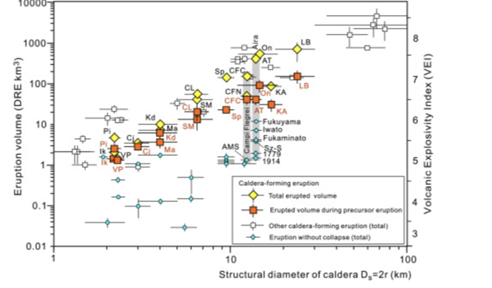
Figure 1: A graph depicting the intensity of a volcanic eruption and eruption volume in a caldera based on the structural diameter of the caldera (Geshi et al. 2014)
Seismicity in Valles Caldera
Valles Caldera is a caldera situated in the Jemez Mountains. Valles Caldera is a dormant caldera therefore there is less seismic activity detected. The seismic surveys that surround the Valles Caldera detect microseismicity, meaning mini-Earthquake activity. For example, there were 6 mini earthquakes detected using the seismic surveys in Figure 2.
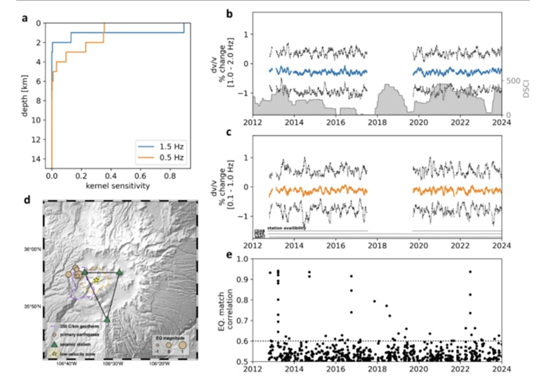
Figure 2: A diagram for 3 graphs (a,b,c, and e) and 1 map (d) of 6 mini earthquakes in Valles Caldera (Rodriguez et al. 2025)
Figure 2 depicts during the past years, the earthquake intensity dv/v % change stayed relatively the same over the years in graph b and c. Graph e indicates that the mini earthquakes match correlation was under 1 which shows a very low intensity earthquake. This pattern concludes that Valles caldera is a dormant caldera when analyzing the seismicity.
Overall, seismicity is an important concept that helps analyze the geophysics of a caldera. Understanding how body waves and surface waves function in a caldera is important for seismic activity. It can be used to track changes like magma activity and seismic velocity change. These are common indicators for earthquakes and volcanic eruptions in a caldera.
-Zara
References
Geshi, N., Ruch, J., & Acocella, V. (2014). Evaluating volumes for magma chambers and magma withdrawn for caldera collapse. Earth and Planetary Science Letters, 396, 107–115. Geshi et al. (2014)
Maier, N., Rodriguez, E. E., Grapenthin, R., Newman, A., Donahue, C., Lindsey, E., Roberts, P., & Devine, S. (2025). Limited surface deformation, seismicity, and seismic velocity changes observed in Valles Caldera over decadal timescales. Journal of Volcanology and Geothermal Research, 460, 108283. Maier et al. (2025)
- Geshi, N., Ruch, J., & Acocella, V. (2014). Evaluating volumes for magma chambers and magma withdrawn for caldera collapse. Earth and Planetary Science Letters, 396, 107–115. 10.1016/j.epsl.2014.03.059
- Maier, N., Rodriguez, E. E., Grapenthin, R., Newman, A., Donahue, C., Lindsey, E., Roberts, P., & Devine, S. (2025). Limited surface deformation, seismicity, and seismic velocity changes observed in Valles Caldera over decadal timescales. Journal of Volcanology and Geothermal Research, 460, 108283. 10.1016/j.jvolgeores.2025.108283